Monday, September 21, 2020

Silverweed, Square-stalked St John's-wort and Round-leaved Mint

These three natives grow on woodland rides in Vicar's Allotment at Trellech near Monmouth: the first two within a metre of each other. The Allotment is on Victorian maps but all these plants are on or near modern forestry tracks.

  • Silverweed, Potentilla anserina
  • Square-stalked St John's-wort, Hypericum tetrapterum
  • Round-leaved Mint, Mentha suaveolens

Silverweed, Potentilla anserina

This plant from the Rosaceae family is so common as it is happy to grow in many types of soil and so recognisable I did wonder about including it in the blog but then I discovered its rich history. Botanical details first! The first two photos were taken in late August on a wet track side. The flower is five petalled and the petals are about twice the length of the sepals. This one is looking a little worn and was the last in bloom. 


The uppersides of leaves vary from silvery, especially earlier in the season as here, to dull green. Most silver leaves had faded by mid September.

They are pinnately cut into 3-12 pairs of oval, toothed leaflets interspersed with additional tiny leaflets which can be seen below.

All of the subsequent photos were taken in mid September in order to focus more on the leaves. The underside seems to show the form better.


The underside of the leaves is usually silvery white. In this colony all of them were.  


The underside is covered with very fine white hairs. The saw toothed leaflets are clear here as well as the additional tiny leaflets.

The history of this common plant is amazing. It was reputed to be picked by Roman soldiers and used as a padding in their boots. This perhaps gave rise to the local name Traveller's Ease in Warwickshire. 

Potentilla means powerful despite its size and anserina means pertaining to geese which enjoy it: hence the local name Goose-grass in Somerset, Gloucestershire, Yorkshire and many other counties.

Until the end of the nineteenth century the roots were eaten in times of famine especially in the Scottish highlands and islands. It was said in North Uist a man could keep himself fed on a square patch of land of his own length by growing Silverweed. It was cultivated and very important in the diet of people in Scotland before potatoes became common in mid eighteenth century.

Roots were baked, boiled, roasted, dried and ground into a rough flour for bread or porridge. They taste a bit like parsnips.

It has astringent, anti-catarrhal, anti-inflammatory and diuretic properties. The dried leaves can be used to relieve sore throats, gum infections and mouth ulcers. They can also be used as a compress. Even more detail is available on the Plantlife website: link at the bottom. 

Pass Silverweed with a respectful nod next time!


Square-stalked St John's-wort, Hypericum tetrapterum

This member of the Hypericaceae family is growing within a metre or so of the Silverweed. It too likes the damp edge of the woodland track. The main ID point is the square stalk with narrow but distinct wings on the angles. The stem is also reddish.


Leaves more or less clasp the stem.


The petals are pale yellow while the sepals are narrow and pointed.


In mid September the plant had moved on to fruit and the sepals can be seen very clearly. Perhaps some of the black glands along the leaf edges are clearer too.


Round-leaved Mint, Mentha suaveolens 

From the Lamiaceae family, I believe this to be Round-leaved Mint and it was accepted as such on #Wildflowerhour on 30/8/20 but there are hybrids. Happy to hear from anyone who on examining a larger range of photos has an opinion! 

Leaves are roundish: slightly less than a circle, suborbicular, or oblong-ovate. They are hairy as are the stems which branch frequently.


The leaves are stalkless or have very short stalks.


The following macro photographs were taken in mid September.

The leaves are strongly rugose and appear from above to have rounded teeth but they are bent downwards like cats' claws. No other Mint has this ID feature except for a few hybrids between this and other species of Mint.


The pale flower heads are spike-like and congested. The calyx appears to be bell-shaped and the flowers, in whorls, have 4 petals with filaments tipped by a red to purple anther.


The style is white and splits into two stigmas at the end.


It would be good to hear from anyone who has an opinion on the ID. Hopefully there is enough information to decide. 

This concludes the look at three plants in Vicar's Allotment near Monmouth. The next blog should cover plants found in Gloucestershire.


Acknowledgements

Harrap's Wild Flowers
Stace 4
https://www.plantlife.org.uk/uk
https://www.first-nature.com/
https://www.naturespot.org.uk/
https://wildflowerfinder.org.uk/
http://www.seasonalwildflowers.com/
http://botanical.com/


Friday, September 11, 2020

Wild Carrot, Wild Angelica and Stone Parsley

 These three natives of the Apiaceae  family have not featured on the blog so far and thus I have the opportunity to look at them over the season from bloom to seed.


  • Wild Carrot, Daucus carota
  • Wild Angelica, Angelica sylvestris 
  • Stone Parsley, Sison amomum 


Wild Carrot, Daucus carota

The umbels are often, but not always, distinguished by a central red flower which may have given rise to the popular name Queen Anne's Lace. There are two theories for this: Queen Anne pricked her finger whilst lace making or the red flower represents her head in the centre of her lace collar. The reddish flower attracted herbalists who used it as a remedy for 'falling sickness'. 

Daucus is an ancient Greek name for this plant and carota simply means carrot. (D. carota ssp sativus, the garden carrot, was introduced from the Mediterranean in the fifteenth century.)

These pictures were taken on 4.8.2020 in Lydney, Gloucestershire


 The other ID features can be seen below. 

There are large conspicuously pinnate bracts below the umbel and as the flower head matures and the seeds ripen it balls into a distinctive shape not unlike a bird's nest. It has the name Bird's Nest in a number of counties including Wiltshire and Yorkshire. Gerard says this name was absorbed into English from the German.

The fruits are egg-shaped, flattened and with long, hooked  spines.


These last two pictures were taken in the same patch of waste ground in Lydney on 9.9.2020.

Herbalists used the whole plant against gout. The seeds were a stimulant and used to treat coughs and jaundice. A poultice of the roots was used to alleviate ulcers.


Wild Angelica, Angelica sylvestris

This is common around Monmouth in damp woodlands and by streams. I look for the distinctive, bulbous, inflated sheath where the leaf and flower stalk joins the stem for the main ID feature. First photo 16.8.2020.


The stems are hollow. The individual five-petalled flowers are usually about 2 mm across. 

Photo below 8.9.2020 on bank of Monmouthshire and Brecon Canal, Abergavenny.


The fruits are ridged, flattened and have two broad wings. Photo below on edge of Wye Valley woodland ride 4.9.2020.


Angelica means like an angel and here sylvestris means growing wild as opposed to the closely related garden variety Angelica archangelica. 

Angelica sylvestris gives a good yellow dye and until the twentieth century was widely used as a vegetable. Local names include Ait-skeiter in Moray meaning oat shooter and referring to the use of the hollow stems by children to fire seeds at friends and Water Squirt in Somerset which presumably is similar though more uncomfortable!

Stone Parsley, Sison amomum

This finely branched, bushy plant I saw for the first time in Lydney on 4.8.2020. It is very distinctive with many small umbels of 3-6 rays often including, as shown here, a single much shorter ray. Bracts and bracteoles are present and very fine. Petals are notched. Uniquely, the crushed foliage smells of petrol.


I am very pleased to report that on 9.9.2020 the plants had set ample seed on a great tangle of  stems.  


This last photo shows, not very well, the probable late final blooms of 2020 but more importantly, and that is why I have included it, the lower leaves with pairs of leaflets and upper finely cut ones.


This concludes a look at three members of the Carrot family over some weeks. I hope you have found it interesting.

As the summer draws to a close I am unsure how many more blogs there will be this year. I have a few more plants that I have found in or near the unofficial nature reserve that is Lydney Railway Station overflow car park and some from woodland rides near where I live. I plan to do blogs to accompany the various Flower Hunts that BSBI and the Wild Flower Society organise.

Acknowledgements

Simon Harrap's Wild Flowers
Stace 4
Grigson The Englishman's Flora
Rose The Wild Flower Key
Mabey Flora Britannica

Friday, September 4, 2020

Field Bindweed, Hedge Bindweed, Large Bindweed

It seems these plants inspire extremes of reactions ranging from those who think them beautiful to those who dislike them intensely. The folk names will show this later but I'll start with the Latin ones.

  • Native Convolvulus arvensis, Field Bindweed
  • Native Calystegia sepium, Hedge Bindweed
  • Calystegia silvatica, Large Bindweed, neophyte-naturalised introduced into cultivation in 1815 and recorded in the wild by 1863.
These are members of the Convolvulaceae family.

Convolvulus arvensis, Field Bindweed

A small white, pink or striped pink and white flowered bindweed which is usually low growing and trailing. It's another common plant I don't see often. These were on the banks of the Gloucester and Sharpness Canal. The corolla is shallowly five lobed and there is one style tipped by two stigmas. 


There is no epicalyx but 2 small narrow bracts on the stem some way below the flower.


The underside of the bloom has 5 dark pink rays. The leaves are variable but generally arrow-shaped.


The roots run long and deep and it is hard to eradicate this plant from field or garden. The names Hell Weed in Northamptonshire  and Devil's Guts in Kent, Lincolnshire and elsewhere perhaps reflect this.  Cornbine in Buckinghamshire, Oxfordshire and other places reflect its agricultural habitat. However the ever reliable imaginative folk of Somerset also called this Fairies' Wine Cups and Fairies' Umbrella! I'll stick with the fairies I think!

The botanical names come from Latin: Convolvulus means twining and arvensis field. Much more accurate and international but perhaps not as much fun!


Calystegia sepium, Hedge Bindweed

These plants were seen in Berkshire and Gloucestershire. 

The roots travel a great distance and even a small piece will produce a new plant.

Mabey considers this a handsome plant with its large white trumpet-shaped flowers and mats of arrow- shaped leaves. I agree with him. The plant does good service in cloaking wire fences as in first picture. The sepals are enclosed by an epicalyx of 2 pouch-like bracteoles but these do not (or hardly) overlap and sepals remain visible. This is the ID feature that is important in avoiding confusion with Large Bindweed. I try to remember it with this sentence: "Hedges have gaps in them."


A children's game is to sharply pinch the base of the calyx causing the whole corolla to pop out and float to the ground while chanting  "Grandmother, grandmother pop out of bed!". My husband remembers the game but not the chant. A whole series of folk names reflect this theme: Grandmother's Nightcap in Devon, Lady's Shimmy (chemise) and  Our Lady's Nightcap in Somerset. Also in Somerset we have Devil's Nightcap and Fairy Trumpet.

Other names refer to the twisting stems: Bearbind in at least Kent and Surrey and Bellbind in Essex. The Devil gets another shot with Devil's Garter in Pembrokeshire.

Wikipedia says Calystegia is derived from two Greek words 'kalux' a cup and 'stege' a covering obviously referring to the calyx.


Calystegia silvatica, Large Bindweed

The flowers are larger than those of Hedge Bindweed with the bracteoles pouched and strongly overlapping thus hiding the sepals. This one had climbed nearly to the top of of a Leylandii hedge in Gloucestershire.


All these twining climbers twist in an anti-clockwise direction.


Acknowledgements

Harrap's  Wild Flowers
Stace 4
Richard Mabey Flora Britannica
Grigson The Englishman's Flora

Friday, August 28, 2020

Common Toadflax, Purple Toadflax and Ivy-leaved Toadflax


  • Common Toadflax, Linaria vulgaris is the only native here. 
  • Purple Toadflax, Linaria purpurea  was introduced to gardens from Italy and recorded in the wild from around 1830. 
  • Ivy-leaved Toadflax Cymbalaria muralis was probably an accidental introduction on imported marble slabs from Italy and recorded in the wild and spreading by 1640. 
All are in the Veronicaceae family.

Common Toadflax, Linaria vulgaris

This distinctive, showy yellow spike was on a rough grassy track verge near Woolhampton, Berkshire. It is supposedly very common but I rarely see it. There were only two spikes about two feet apart but enough! The blooms are snap dragon-like, 2 lipped, yellow with a large orange-yellow boss on the lower lip; the spur is more or less straight.


The narrow leaves are strap-shaped and grey-green. It was a weed in Flax crops (looking like Flax, Linum, until the flowers developed) and Linnaeus named it after flax. The toad part of the name appears to be linked to the shape of the flower resembling both a small toad and its mouth when wide open.

Local names seem to reflect the shape in Gaping Jack (Somerset) and Lion's Mouth (Devon) and Rabbit-flower (Devon and USA). Many names like Bacon and Eggs (Wiltshire) refer to the colour.

The apothecaries' name was Urinalis as the colour suggested urine. It was used as a diuretic and  presumably the colour also suggested it as a treatment for jaundice. During its long history in herbal medicine the leaves were used to make a laxative tea and an ointment for skin diseases.


Purple Toadflax, Linaria purpurea

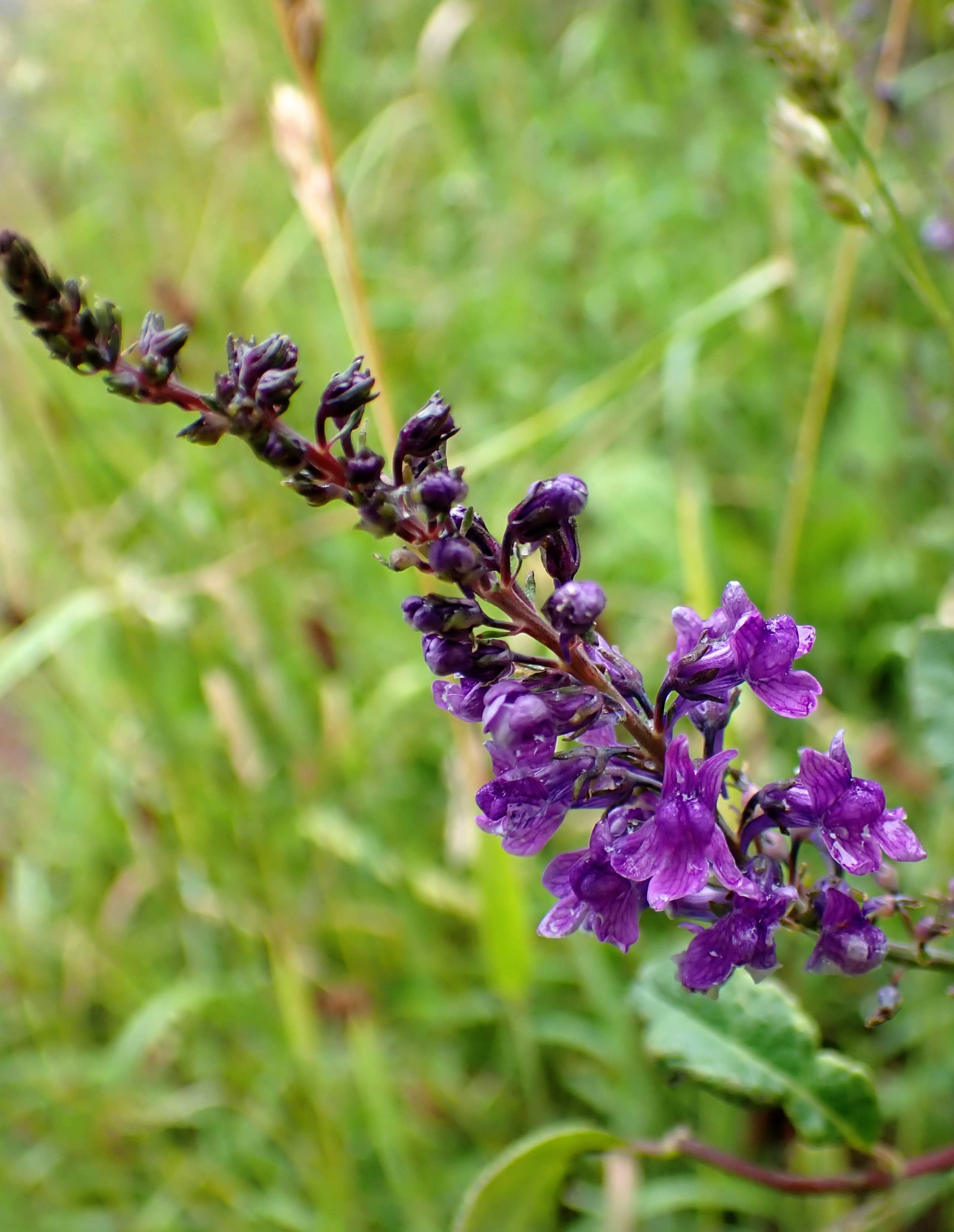
A common garden escape. This one probably is such on a village bank near Monmouth. The tall slender spikes of snapdragon-like flowers are distinctive. There are darker purplish veins on the corolla. The stems are usually purplish and leaves strap shaped. The lower leaves grow in whorls.


Ivy-leaved Toadflax, Cymbalaria muralis

This is likely to have been imported to London in 1640 on Italian marble slabs. As garden walls went up apace in the next 300 years it was a good time for a species that likes growing between rocks and stones. It acquired the name Oxford Weed because it became so well established on the walls of Oxford colleges. It was popular as an ornamental up to the end of the nineteenth century but is no longer deliberately planted. These photographs were taken in Abergavenny and my garden.


The leaves are glossy and usually 5 lobed with palmate veins. Solitary flowers are lilac (I have seen white ones in St David's, Pembrokeshire) with a yellow spot. There is a short curved spur. They are solitary in the leaf axils. 

The flower stalks bend towards the light, but as the fruit develops the stalks gradually recurve towards the growing surface so the seeds can lodge in any likely space or crack and establish a new plant. I hope this can be seen happening below. It certainly explains, along with some rooting at lower nodes, the successful spread of this plant.


The Latin name Cymbalaria refers to the shape of the leaves which were thought to resemble cymbals. Local names include Creeping Jenny, Mother of Millions and Nanny Goat's Mouths in Devon alone. 

It tastes like watercress and has been eaten in salads and the flowers give a clear but not permanent yellow dye.

Thank you for reading. I hope you have found out something new about these common, well known  plants.


Acknowledgements 

Harrap's Wild Flowers

Stace 4

The Englishman's Flora Grigson

Flora Britannica Richard Mabey

https://www.plantlife.org.uk/uk

https://www.first-nature.com/

http://botanical.com/

http://seasonalwildflowers.com/


Thursday, August 20, 2020

Perforate St John's-wort, Hairy St John's-wort, Marsh St John's-wort, Vervain and Yarrow

When I started researching this blog it was to be on the three St John's-worts, Hypericaceae, and I already knew that Perforate had a long history as a plant of magic and medicine. I quickly discovered that there were at least nine herbs of St John and as I had recently seen two of them, Vervain and Yarrow, I decided to include them. I had an amazing journey of discovery ahead. I have had to summarise the lore and history as a lengthy blog could probably be done on each. 

Perforate St John's-wort, Hypericum perforatum

A native, found here in a Gloucestershire car park, is one of the most famous of European plants in white magic but I will deal with the botanical details first.

The bright yellow petals are at least twice as long as the sepals which are narrow and pointed. Stems are round with 2 opposite raised ridges.


Sepals and petals have a few stalkless, black glands.


The abundant translucent dots in the leaves are the main ID feature for me. These are resin glands. The dots were interpreted as this herb being a remedy for wounds. It has been used to ease a wide variety  of physical conditions including dysentery and is now mostly used to prevent depression and to ease burns and wounds. 


This plant, which had been known from pagan times, was later given a name from Christian culture.

It is likely a pagan rite was adopted by Christianity. The plant was picked on the morning of June 23rd, with the other Herbs of St John, before sunrise while still wet with dew. In the evening fires were lit and the flowers smoked to make them more efficacious in medicine and in protecting farm animals, horses and men against all evil. The smoke drifted across the fields and protected all it touched from lightning, drought and field fires.


Hairy St John's-wort, Hypericum hirsutum

Another native, this was growing on a woodland ride near Monmouth.


The stems and leaves are conspicuously hairy. The leaves are strongly veined with many translucent dots.


The petals are a pale yellow with stalked black glands on petals and sepals. These can be seen here.


Marsh St John's-wort, Hypericum elodes

This grows in mats around the lake at Woorgreens Nature Reserve near Coleford, in the Forest of Dean. The leaves are softly and densely hairy. The flowers do not open widely and on my first visit on a grey day they were tightly closed! The stems creep and the flower stems are erect. There are reddish glandular hairs on the flowers but no black glands on the plant.


Vervain, Verbena officinalis

Mabey says this plant of the Verbenaceae family is 'scrawny and nondescript'! I don't see it very often so always enjoy it. I found it in a car park in Gloucestershire and Gerard's note that it is found in 'untilled places, neere unto hedges, highwais and ditches' still holds true.


The stems spread and the flowers open 1 -2 at a time. The corolla is split at the mouth into 5 lobes divided between a 2 lobed upper lip and a 3 lobed lower lip. 


Leaves are opposite (upper without stalks) but have narrow wings.The stems are four angled.

It has been cultivated in the UK since the Stone Age and was extensively grown in the Middle Ages as a medicinal plant. Garlands of it were worn on St John's Eve. It was prescribed for wounds, headaches, stones, eye troubles, childbirth and many other conditions: in fact a cure all. On the Isle of Man a piece of the herb was frequently sewn into clothing for protection. It was traditionally associated with the gods of war and gun flints were sometimes boiled with rue and Vervain to make them more effective. In 1767 a publication on the virtues of Vervain went into 16 editions in 10 years.

Gerard was uneasy about its reputation of magical properties and writes 'Many odde olde wives tales are written of Vervain' and Michael Drayton wrote in 1627  'Therewith her Vervain and her Dill, that hindereth witches of their will...'

The Church said it grew under the Cross at Calvary which could be reflected in the name Holy Herb in Somerset.


Yarrow, Achillea millefolium


The final Herb of St John in this post: a commonplace native much overlooked plant of the Asteraceae family and perhaps the one with the most surprising history. A powerful herb in Anglo-Saxon times associated with divination rituals, used as a charm against bad luck and illness. It was used as a staunching herb and was called Carpenter's Grass in places. It was a wound herb particularly recommended for wounds caused by iron. Gerard's Herbal associates it with Achilles who staunched the bleeding of his warriors' wounds with it and who gave his name to it.

Grigson says the Irish hang it in houses on St John's Eve to avert illness. An old German name was 'Salvation of all damage'. Will you ever look at this plant in the same way again? It is an ingredient in some modern rescue remedies or emergency essences.

The flowers are in dense flat-topped clusters and the anthers are orange. 


The foliage is finely cut and gives rise to 'millefolium'. The stem is angular.


There is so much folklore associated with these plants I have only been able to scratch the surface of traditional and modern beliefs.

More info can be found in my sources and in many other books and webpages. Happy hunting!

According to Grigson Herbs of St John include not just Perforate St John's-wort, Vervain, and Yarrow but Mugwort, Greater Plantain, Corn Marigold, Dwarf Elder, Ivy and Orpine or Stonecrop.


Acknowledgements

Harrap's Wild Flowers
Stace 4
Grigson An Englishman's Flora 
Mabey Flora Britannica